The tiny Easter Island, a special territory of Chile since 2007, covering an area of 163.6 km² and separated from the rest of the Polynesian chain by the ocean water, is surrounded by three volcanoes that give the island a triangular shape. Although the island is full of volcanic soil, it is a picturesque place with surging breakers, precipitous cliffs, towering volcanoes and open, windswept slopes. But, what attracts the visitor most, are the island’s iconic giant stone statues with their brooding eyes staring into the far-off sky over a barren landscape, facing away from the ocean.
The statues or moai, meaning “statue” in Rapa Nui language, are carved out of buff-coloured volcanic stone called moai. The average height of the moai is about 4 m, usually weighing around 13 tons. The tallest of some 900 such statues erected, stood almost 10 m and weighed 82 tons. The heaviest moai was shorter, but weighed 86 tons. One unfinished sculpture, if completed, would have been nearly 21 m tall with a weight of about 145-165 tons.
A notable research on the statues was done in 1914-15 by Katherine Maria Routledge (1866-1935), an English archaeologist and anthropologist. She described the island as a place where the past is the present and where the shadows of the departed builders still possess the land. Other researchers include the American W. J. Thomson (1886); Alfred Métraux (1902-1963), Swiss and Argentine ethnologist; Henri Alfred Lavachery (1885-1972), a Belgian who was the first professional archaeologist to visit the island; Fr. Sebastian Englert (1888-1969), a German Franciscan missionary and linguist, known for his pioneering work on Easter Island in 1935-39, where a museum is named after him; Thor Heyerdahl (1914-2002), the famous Norwegian adventurer and ethnographer (1955-56); and American anthropologist William Thomas Mulloy (1917-1978). Due to the painstaking efforts of these scholars many toppled statues in the late 18th and early 19th centuries, possibly resulting from European contact or internecine tribal wars, were restored to their original positions.

Who built the statues and what did they signify?
The inevitable question as to who carved such magnificent statues has given rise to many surmises. Some scholars have disclosed amazingly interesting stories, saying that Easter Island was the Lost Continent. Others opined that it could have been inhabited by beings from outer space or the islanders were direct descendants from ancient Egyptians. However, modern researchers are unanimous in theorising that the people who carved the moai were none other than the Polynesians.
Contrary to these suppositions, the islanders have their own tale of descent. Their legends have it that their religious leader named Hotu Matu was defeated in a battle and was forced to leave his homeland: archipelago of Hiva. One of his men had a vision of a new homeland somewhere in the direction of the rising sun and seven men were sent to locate it, thus discovering Easter Island. Hotu Matu arrived in Easter Island with various plants and animals, but he did not live for long. Before his death he divided the island among his children: a reason for the island being divided into so many groups. Scholars do agree to this native legend to some extent. They believe that the descendants of Hotu Matu created these great statues, possibly from 1110 A. D. till 1650 A. D. the year in which all construction was halted as revealed by the radiocarbon dating.
Today many archaeologists are of the view that the statues signify symbols of religious and political authority and power and also a representation of the deceased ancestors of the indigenous clans. In ancient Polynesian religions, carved stone and wooden objects, when properly fashioned and ritually prepared, were thought to be charged by a magical spiritual essence called mana which, according to local tradition, was preserved in the hair. The more recent moai carried pukao on their heads. Pukao were hat-like structures or topknots, carved out of red scoria (a basaltic lava). Red is considered a sacred colour in Polynesia. Meanwhile, a 2019 study concluded that the moai might be related to improving soil fertility and thereby critical food supplies.
American archaeologist Jo Anne Van Tilburg, who has studied the moai for many years, believes that they may have been carved in the image of various paramount chiefs. According to her, the statues may have played the role as ceremonial conduits for communication with the heavenly gods. She asserts that their physical position between earth and sky puts them on both secular and sacred ground, thus mediating between sky and earth, people and chiefs, and chiefs and gods.
In another 1979 study, a team of archaeologists discovered that the hemispherical or deep elliptical eye sockets of the moai were designed to hold coral eyes with either black obsidian (a kind of volcanic glass) or red scoria pupils.
The transportation of the statues
The question as to how the moai were transported has given birth to many assumptions. According to the traditions of the island, the statues were filled with supernatural powers (mana) and they themselves walked to their appointed places. Another interesting story is that carpets of sweet potatoes and crushed yams were laid on the slopes and the statues were slid along them. Recently, Mulloy suggested that the statues were put on a Y-shaped curved bottom sledge, arguing that the jutting out belly and chin of the moai was not executed to give any style but was a result of the use of the Y-shaped sledge. Once the statue was placed on the sledge, the statue was pulled by the ropes on a road covered with reeds and grass.
Explorers become exploiters
The first recorded European visitor to the island was the Dutch explorer Jacob Roggeveen (1659-1729). He found it on Easter Sunday on 05th April 1722 and named it “Paasch-Eyland” (18th century Dutch for “Easter Island”). (“Isla de Pascua”, the island’s official Spanish name after it was annexed by Chile in 1888, also means “Easter Island”). But, the island has been known by many other names as well. The phrase Te pito o te henua is said to be the original name of the island. French linguist Alphonse Pinart (1852-1911), based on the Rapa Nui word pito, also meaning ‘navel’, translated the phrase as “the Navel of the World”.
Roggeveen found out that the islanders were living in thatched huts and could barely make a meagre living by doing a little bit of cultivation. In 1770 the Spanish navigator Felipe González de Ahedo (1714-1802) visited the place and named it “Isla de San Carlos” or “St. Charles’ Island”. Four years later the great English explorer Captain James Cook (1728-1779) came to the island, followed by the French Admiral Jean François La Perouse (1741-1788). All these visits were very brief and hardly gave any new information to the world about the island except that the islanders numbered 3000-4000, that they practised cannibalism, and that tribal chiefs were always warring against each other.
By the 19th century the situation changed and soon the isolated islanders were transformed into slaves. In 1805 the American ship ‘Nancy’ carried away 22 islanders as slaves while Peru also invaded the island from 1859 to 1862, about 1000 islanders being shipped off to Peru as slaves. Many of the enslaved inhabitants were skilled artists and with them the secrets of the carving trade too died out. Of the 100 islanders who were released, only 15 managed to reach the island but they were infected with the dreaded small pox which spread rapidly and the island population decreased further. By 1877 only 111 inhabitants were left and when the Chilean colonists arrived they found the islanders living in complete misery and poverty. The island became a possession of Chile and the giant statues began to arouse the interest of the world.
An ecological disaster?
It is evident that formerly Easter Island, now a UNESCO World Heritage Site since 1995, was covered with green vegetation, teeming with animal life. Around 1000 A. D. palm forests had covered about 70% of the island. Today there are hardly any trees, except for a few bushes, ferns, grasses, sedges, etc. The natives grow bananas, sugar-canes and sweet potatoes and breed domestic fowls, goats, cattle and sheep.
What denuded this once fertile island of its ancient palm woodland has puzzled many ecologists. In 2005, Pulitzer prize-winner Jared Diamond of the University of California concluded that the inhabitants of the now depopulated island had cut down the palms to build sledges for statues and roofs for homes: an act of self-destruction.
But, Terry Hunt and Carl Lipo of the University of Hawaii, presented another explanation in a series of papers. Based on DNA evidence and chewed palm remains, they proposed that Polynesian rats which the immigrants brought with them had eaten palm tree nuts, thus triggering deforestation.
However, German ecologists Andreas Mieth and Hans-Rudolf Bork from the Christian-Albrecht University of Kiel do not subscribe to this hypothesis of a major rat impact to account for the deforestation of the island. Referring to the several millimetre-thick charcoal layers from fires, distributed over large areas of the island, they presume instead that widespread fires in the woodland can be the only reason for the landscape denuded of trees.
Still a fourth suspected cause has been proposed: drought. But, according to scholars, this does not seem to have a big effect on the lush vegetation which the island was once covered with.
The unfolding of events on Easter Island may sound a note of dark warning and forebode a bleak future for humanity. “Easter Island’s isolation makes it the clearest example of a society that destroyed itself by overexploiting its own resources”, writes Diamond. He says that humanity contains the seeds of its own destruction. ***
]]>He masterminded the Sept 11, 2001 attacks on USA and indicted in absentia for 1998 bombings of U.S. embassies in Kenya and Tanzania killed over 224 people. Osama Bin Laden’s No. 2 took over Al Qaeda after his death and the FBI listed a $25 million reward for his information.
“People around the world no longer need to fear the vicious and determined killer. The United States continues to demonstrate our resolve and our capacity to defend the American people against those who seek to do us harm,” U.S. President Joe Biden said from the Blue Room Balcony of the White House.
]]>The largest events occurred in the country’s capital, where families and anti-government protesters gathered across Ottawa. The official celebration took place in LeBreton Flats because of renovations at Parliament Hill, and featured a visit from Prime Minister Justin Trudeau and musical acts.
]]>Lines and patterns depicting geometric, animal, bird and plant shapes have been drawn on the dry plains of southern Peru near the town of Nazca. These bewildering designs, visible from an aircraft and the surrounding foothills, have given birth to numerous suppositions and superstitions. Yet, despite all the research, no plausible explanation has been offered so far to unravel the mystery of the intricate designs, the existence of which was first mentioned by a Spanish chronicler in the 16th century.
Certain mysterious gigantic designs cut in the coastal desert floor, near the town of Nazca in southern Peru, have given archaeologists something to rack their brains over. These designs, known as geoglyphs, dating back to nearly 2000 years, have been created by scraping the rocky surface off the yellow subsoil to appear as straight and parallel lines, triangles, rectangles, quadrangles and trapezoids while spirals and zigzags form more distinct shapes of a monkey, a dog, a spider, a lizard, a whale, a hummingbird, a condor, and other birds. Another curious and inexplicable design concerns a slender rod with line and reel, similar to one used by fishermen.
The site of the world-renowned Nazca lines, which was declared a UNESCO World Heritage Site in 1994, is found over 300 km southeast of Lima, the capital of Peru. In total, there are more than 800 straight lines, 300 geometric figures and 70 animal, bird and plant designs, called biomorphs. Some of the furrows extend over a distance of nearly 50 km, crossing valleys and ravines and mountains, while the biomorphs range from 15 to 366 m in length. The new technology with drones has also helped discover the hitherto unnoticed figure of a relaxing cat when plans were underway to create a new path leading to an observation platform that would serve as a vantage point for visitors to see the geoglyphs. According to the Ministry of Culture in Peru, the figure was on the verge of disappearing owing to its existence on a steep slope prone to natural erosion.
The mention of the Nazca lines was first made by Pedro Cieza de León (1520-1554) in his book of 1553. Being a Spanish conquistador and chronicler of Peru, he described them as “trail markers”. Then, in 1586, Luiz Monzón reported having seen the “roads”. Although the crisscrossed lines were partially visible from the nearby hills, Peruvian military and civilian pilots were the first to report them in the 20th century.
In 1927 Peruvian archaeologist Toribio Mejía Xesspe spotted them while he was hiking through the foothills. He discussed them at a conference in Lima in 1939. His research led to the conclusion that the lines formed part of ancient sacred roads. Xesspe never flew over the area and so only saw the straight lines and failed to see the figures.
An astronomical calendar?
While Dr. Paul August Kosok (1896-1959), an American historian from Long Island University in New York, was in Peru from 1940-41 to study its ancient irrigation systems, he flew over the land and thus was afforded the opportunity to be the first to make an in-depth aerial examination of the lines. He chanced to see how lines converged on the horizon at the winter solstice in the Southern Hemisphere. The winter solstice occurs when either of Earth’s poles reaches its maximum tilt away from the sun and it happens twice each year. Kosok began to study how the lines might have been etched and he tried to fathom their meaning and purpose. Finally, he came to the conclusion that this unique area could be named as “the largest book of astronomy in the world”. According to him, the designs were laid in order to show the paths of the stars in such a way that the agricultural work of the year could be organised in due season.
Kosok also noticed that some of the radial centres were formed by small mounds, upon which vague structural outlines, undoubtedly of great antiquity, could be seen. No one knows whether they are contemporary with the linear tracings or they were built later to give the place a sacred character.
Kosok’s work was continued by Maria Reiche (1903-1998), the famous German-born Peruvian mathematician, archaeologist and technical translator, nicknamed the “Lady of the Lines”. She researched the desert drawings exhaustively for 40 years until her death, even taking up residence in a small house near the site to protect them single-handedly from reckless visitors. Reiche shared with Kosok, her predecessor, the theory of an astronomical calendar. Some Peruvian archaeologists too supported the Kosok-Reiche theory, but Johan Reinhard, a National Geographic Explorer-in Residence, debunked it in his book on the origin of Nazca Lines, claiming that the lines led to places where rituals were performed to obtain water and fertility for crops. He said that in such an arid region with so little rain, water was clearly an important factor. Most of the furrows are wide enough for a procession to pass along them which would suggest that they might have been used for ceremonial purposes, says French author Robert Charroux (1909-1978), a pioneer of the theory of ancient astronauts.

According to Reinhard, spiral designs have been found at other ancient Peruvian sites as well. Claiming that animal symbolism is common throughout the Andes, he argued that spiders are thought to be a sign of rain, hummingbirds are associated with fertility and monkeys are found in the neighbouring Amazon rainforest. (Peru has the second-largest portion of this rain forest after Brazil, comprising 60% of the country)
Johnny Islas, presently Peru’s chief archaeologist for the lines, says that the latest research indicates that the purpose of the lines was to ask the gods for water and fertility in this dry area. Anthony Francis Aveni (born in 1938), an American anthropologist and archaeoastronomer, agreed with Reinhard, saying that the straight lines and trapezoids are related to water.
The British-born American Astronomer Gerald Stanley Hawkins (1928-2003) used a computer in 1960 to check the astronomical interpretation of the Nazca patterns. The study proved that they were not designed as a celestial calendar.
An astroport for aliens: a crackpot theory?
Some people believe that the designs must have been made by unknown extraterrestrial beings in a remote past while others hold the view that the Nazca desert may have been used as an astroport by interstellar spacecraft thousands of years ago. Erich Anton Paul von Däniken (born in 1935), a Swiss author of several books (originally written in German and translated into English by Michael Heron) and a key figure for popularising the alien involvement in the culture and religion of early humans, suggested that the Nazca lines were the work of ancient astronauts. Däniken’s books attracted so many tourists to the Nazca region. But, the theories, expounded in his books, including the best-selling Chariots of the Gods – Was God an Astronaut?, published in 1968, have been rejected downright by both orthodox scientists and Christian theologians.
Hot air smoke balloons: Woodman’s theory
Jim Woodman, an American explorer in the 1970s, theorised that the Nazca people could have been the first inventors of hot air smoke balloons. He based his argument on the assumption that the geoglyphs could be sighted only from an aircraft and hence they could not have been drawn without aerial assistance. To support his theory Woodman cited pottery he had found in Nazca burial grounds that depicted hot air balloons. He also suggested that the Nazca people would have sent off their dead in these balloons to fall into the Pacific Ocean, which symbolically signified the journey of the deceased towards the Sun. Similar to the theories of Däniken, the suppositions of Woodman were debunked by experts. Firstly, they pointed out that the Nazca lines can be seen from the surrounding hills as well, as shown by archaeologist Xesspe. Secondly, the Nazca people, like the Incas, buried their dead without sending them off to a celestial destination. Thirdly, critics contended that the winds in the Andean region blow from west to east and so the balloons would not float towards the ocean, but crash instead onto the mountains.


No consensus of opinion so far
It is also presumed by some scholars that the Nazca people used to read the different weather signs from the flight patterns of seabirds. Native Indians of Peru still believe in the magical powers of animals and they see the shapes of these animals in the stars. A few theorists are of the view that the figures of the animals are reproductions of the shapes made by constellations. It is also theorised that the lines could have been the magical religious cult expressed in a theatrical ritual.
Still others conjecture that they were places of assembly or of astronomical observation. According to some, the region would have been a ground, guided by the spirits. Burnt offerings were made to the Nazca gods there, suggest others. Yet, no one has come to a single platform for a common agreement. The Nazca etchings, a striking testimony to Peru’s rich pre-Columbian heritage, still remain one of the world’s greatest archaeological conundrums.
Today the Nazca region is also crossed by the 30,000 km long Pan-American Highway, stretching from Chile to Alaska. The government of Peru has banned walking or driving over the Nazca area except by special permission. Yet, the encroachments over the years into the protected Nazca area by squatters raising pigs, were reported to be endangering the geoglyphs.
Since the 2000s, tourism in Peru makes up its third largest industry next to fishing and mining. Tourism is the most rapidly growing industry there and it is growing faster than any other country in South America. ***
]]>Most recognisable figures from the capitol hill siege after being pictured with a US flag painted on his face and wearing horns and a bearskin headdress. He referred to himself as “the QAnon Shaman”. Just days after the riots, he got arrested and was in custody for nearly 11 months.
Chansley told the FBI that he came to DC in January “at the request of the president” that all “patriots” come to the city.
Also he stated to the judge, he wants to “evolve” and was “wrong for entering the Capitol”. “I have no excuse,” he said.
Adding more, he has been asking himself “what would Jesus do?” and likened himself to Indian independence leader Mahatma Gandhi, saying: “What if we all judge Gandhi based on the fact that he beat his wife before his spiritual awakening?”
Chansley was carrying a spear in the Capitol. Prosecutors also say he led other protesters in and he left a threatening note for former Vice-President Mike Pence saying “It’s only a matter of time,Justice is coming!”
According to the prosecutor, “His consistent rhetoric before and after the event, and his apparent ability to carry out his intentions of violently removing the ‘traitors’ in our government, is clear from the evidence in this case,” .
Now he claims to have disavowed Mr Trump and QAnon both.
In September, his attorney told the court that his client was “non-violent, peaceful and possessed of genuine mental health issues”. That defence didn’t work.
Followers of the QAnon conspiracy theory believe that former President Donald Trump was waging a secret war against a cabal of Satan-worshipping paedophiles in government, business and the media.
]]>Powell, a four-star general who last held public office in 2005, passed away on Monday, due to the Covid 19 complications. His family posted this statement on Facebook. He was 84.
Mr Powell remembered as one of the greatest leaders and a very good family man in the US history.
]]>
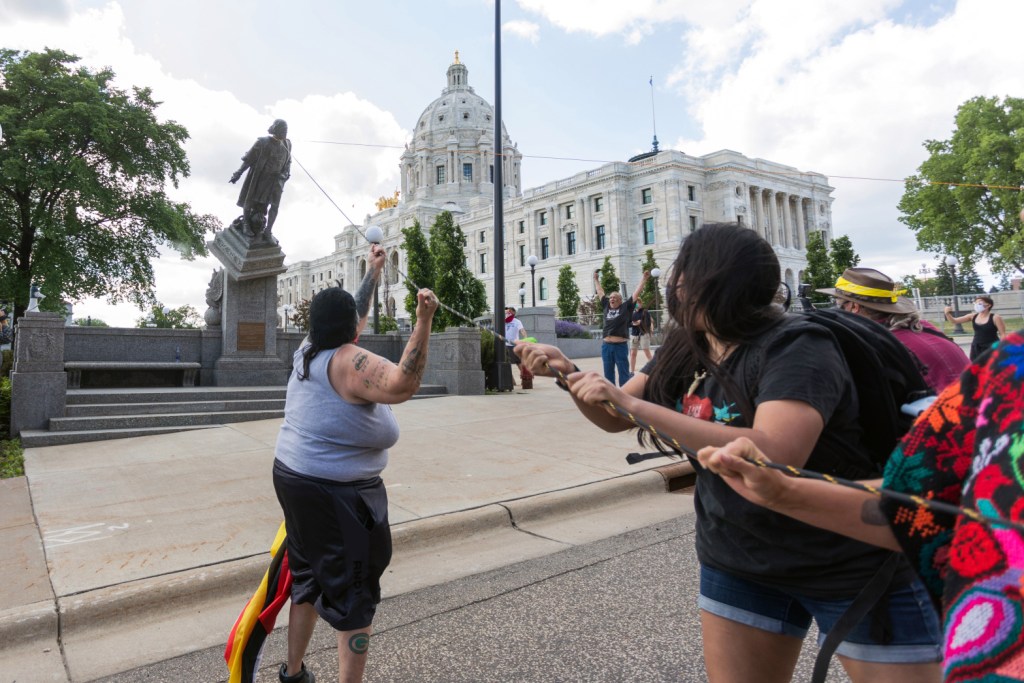
As we all know, Christopher Columbus, the 16th century Italian explorer and navigator from Genoa, is credited with the discovery of the New World, but now this fact seems to be losing ground, as a growing number of reputable academics tend to cast doubt on it. An overwhelming body of archaeological and historical evidence shows that many other nations too had reached the shores of the Americas well before Columbus. Yet, the opponents of this theory, describing such evidence as circumstantial or ambiguous, have dismissed the pre-Columbian transoceanic voyages as pseudohistory or fringe science.
Although the conserved oral, written and pictorial traditions of the Native Americans with regard to their original home have nothing to do with Asia, most anthropologists now agree that the forebears of the Amerindians crossed over the land bridge-the then frozen Bering Straits-from Siberia to Alaska tens of thousands of years ago and eventually populated the Americas from Alaska to the southern tip of Tierra del Fuego in South America. Many still retain racial features typical of the Mongoloid (Chinese) people, namely, thin eyes, straight black hair, broad faces and heads. Strangely, some of them founded great empires in Mexico and Peru while others have remained in a primitive state even to this day as wild tribes as in the case of the dwellers in the Amazonian jungles. Hence, these Amerindians are considered to be the earliest settlers in the Americas.
African voyagers before Columbus
Thousands of years before Christopher Columbus (1451-1506) the West Africans and ancient Egyptians travelled to the New World, contributing immensely to the early Olmec culture in Mesoamerica (Central America) by introducing the art of pyramid-building, mummification, mythology, writing, mathematics and even a sophisticated calendar. Despite the general notion, the Africans were skilled and intrepid mariners who crossed the surging waters of the Atlantic Ocean in their primitive boats, depending on currents, without an oar, rudder or sail, as demonstrated by modern attempts to prove such navigation. Leo Wiener (1862-1939), an American historian and linguist of Polish-Jewish origin, in his book on this subject (1920), wrote that Columbus himself had quoted in his journal the Amerindians who had told him that black-skinned people had come from the south-east, trading in gold-tipped spears.
Carved colossal heads, some weighing about 24 tons and standing about 2 m, excavated at Tres Zapotes in Central Mexico, have been attributed to the aforesaid Olmec culture (dating back to 1200 B. C.), which predated that of the Aztecs, Mayas and Incas. The heads in question depict an unerringly (African) Negroid features. Ivan Gladstone Van Sertima (1935-2009), a Guyanese-born British professor of African Studies and Michael Douglas Coe (1929-2019), a leading American historian, are of the opinion that later Mesoamerican civilisations were based on the Olmec culture.
It is said that in 1311 A. D. King Abu Bakr II, the ruler of the West African Mali Empire (1235-1670), sent out a large fleet of ships of trade material (crops, animals, cloth, etc.) along with African knowledge of astronomy, religion and arts. But critics refute this story, saying that such a king never reigned and they attribute the voyage instead to Muhammad Ibn Qu, the eighth Sultan of the empire, who led a marine expedition into the Atlantic Ocean never to return. However, Van Sertima and the Malian researcher Gaoussou Diawara suggested that the voyage did reach the New World. The former even suggested that the Aztec god Quetzalcoatl was a visitor from Africa (he faced severe criticism from mainstream scholars for this theory) and Wiener drew similarities between the West African Mandinka ethnic community and Mesoamerican religious symbols like the winged serpent and the sun disk.
The Greek historian and geographer Herodotus (484 B. C. – 425 B. C.) recorded in 445 B. C. the seafaring skills of the ancient Pharaohs. Black Egyptians, under the guidance of King Ramses III, who reigned from 1186-1155 B. C., sailed to the Americas and settled there. In 1992 the toxicologist Svetlana Balabanova found in Egyptian mummies traces of cocaine, hashish and nicotine, known to be derived from plants native to the Americas, which suggested that the Ancient Egyptians could have acquired these narcotics only via trade with the Native Americans. Other curiosities that would support the transatlantic voyages are the Egyptian artifacts from North America and Algonquin writings of Eastern Canada as well as Egyptian place names in the Grand Canyon.
Prof. Everett Borders points out the nature of the American pyramids as a strong indication of the African presence: pyramids of the Egyptian and Olmec cultures were both placed on the same north-south axis and the construction methods were strikingly identical. All these pyramids, tellingly, served the same dual purpose: tomb and temple.

Are Phoenicians the first voyagers to the New World?
The Phoenicians, an ancient Semitic-speaking people of the Near East, were the finest sailors of the ancient world. Originating in the eastern Mediterranean region in modern Lebanon, they claimed that they were the first discoverers of the Americas. Even Diodorus Siculus (90 B. C.-30 B. C.), the ancient Greek historian, agreed with their claim. The proponents of this theory have offered a number of evidences, among them the famous world map, compiled in 1513 by the Turkish admiral and cartographer Piri Reis (1465-1553), which shows the coast of Brazil with reasonable accuracy, including the Azores and Canary Islands in the Atlantic Ocean and possibly Japan as well. The surviving fragment of the map, drawn on gazelle skin parchment and presently kept in a museum in Istanbul, Turkey was compiled from older charts of world maps that were housed in the giant library at Alexandria before a fire destroyed it completely in 47 B. C.
The American palaeontologist Mark McMenamin (born in 1957) proposed that Phoenician navigators reached the shores of the New World around 350 B. C. and the Phoenician state of Carthage in present-day Tunisia minted coins which, according to him, bore a map showing the Americas. But later, he found that these coins were modern forgeries. Similarly, in 1872, on a Brazilian plantation, a stone of an unknown inscription was found. Ladeslau Netto, the then Director of the National Museum in Rio de Janeiro, translated it which read that the sailors were at sea to appease gods. But this story too was rejected by the American maritime historian Samuel Eliot Morison (1887-1976), and the Hebrew scholar Frank Cross (1921-2012), who interpreted the Dead Sea Scrolls (ancient Jewish manuscripts found in the Qumran Caves in the Judaean Desert). Another stone found in 1658 in Massachusetts, confirming the Phoenician landfall in the Americas, was refuted as a hoax by the Italian-born American historian Roberto Sabatino Lopez (1910-1986).
Jewish and Arab seafarers
The Bat Creek inscription (originally thought to have been written in the language of the Cherokee Indians of the U. S.), excavated from a Native American burial ground in Tennessee in 1889 and Los Lunas Mystery Stone, a large boulder with an inscription, reportedly discovered from New Mexico in the 1880s and later subjected to vandalism in 2006, have led some to presume the possibility of the arrival of the Jews in the Americas after they fled from the Roman Empire during the Jewish-Roman Wars in the 1st and 2nd centuries. The American archaeolinguist Cyrus Herzl Gordon (1908-2001) believed that the Mystery Stone, with writings in Old Hebrew (closely related to the Phoenician script), belonged to the Samaritans, an ethnoreligious group originating from the Israelites. Yet, sceptics, arguing that this script was known to scholars by at least 1870, do not preclude the likelihood of a modern hoax. Meanwhile, John Philip Cohane, an American author on etymology, claimed that many geographical place names in the U. S. are of a Semitic origin.
Early Chinese accounts mention that Muslim navigators landed at a region named Mulan Pi. Although this name is generally identified as Spain and Morocco, some fringe theorists say that it could be a part of the Americas.
The Arab historian Abu al-Hasan Ali al-Mas’udi (871 A. D. -957 A. D.) recorded that Khashkhash Ibn Saeed Ibn Aswad, a Moorish navigator from Islamic Iberia, crossed the Atlantic Ocean and came to a previously unknown land in 889 A. D. and returned with a shipload of valuable treasures.
Chinese discoverers of the New World?
It is assumed that the Chinese traveller Hui Shen and four other Buddhist monks set sail in 459 A. D. and crossing the North Pacific, may have reached North America, then perhaps sailed down to the coast of Mexico. Shen described horses, cattle and deer, used to draw carts. But the American Indians had not seen wheeled vehicles before the Spanish conquests. Hence, Shen’s description presents inevitable contradictions.
In 1975, Betty Jane Meggers (1921-2012), an American archaeologist, asserted that the Olmec civilisation came into being due to the influences of the Shang dynasty of China. In a 1996 book, Mike Xu claimed that bronze tools from La Venta, an Olmec site in the Mexican state of Tabasco, bore Chinese characters, but orthodox Mesoamerican experts do not support these claims.
The British author and retired submarine lieutenant-commander Gavin Menzies in his book noted that the treasure fleets of the Ming admiral Zheng He reached the Americas in 1421. Historians, dismissing his hypothesis as groundless, argued that the admiral landed at the eastern coast of Africa.
Charles Frambach Berlitz (1913-2003), the renowned American polyglot and the grandson of the founder of the famous Berlitz Language Schools, in his enthralling book Mysteries from Forgotten Worlds (1972), argues that the Amazon pictographs may be representations of monsters or stylised lizards as in China and Mayan dragons do resemble the Chinese dragons to an amazing degree. He also cited the Oriental motifs of the lotus and the swastika (which the Chinese called ‘Heart of Buddha’ more than 2000 years before Hitler heard of it) in ancient Mexican art. Berlitz quoted the Hai King (circa 2250 B. C.) who described a voyage through a “Great East Ocean” and a long trip southwards, including an inland excursion to a “great luminous rock wall valley”, presumed to be the Grand Canyon. The working knowledge of Berlitz of some 30 languages was a boon to him to read many ancient texts in the original.
Japanese connection
Emilio Estrada Carmona (1855-1911), an archaeologist and a President of Ecuador, found that the pottery belonging to the Valdivia culture of coastal Ecuador, dating back to 3000-1500 B. C., illustrated similarities to pottery from the prehistoric Jomon period (14000-300 B. C.) in Japan. But chronological problems have led to the implausibility of this notion on the part of most archaeologists.
Nancy Yaw Davis, an Alaskan anthropologist, asserted that the Zuni people of New Mexico exhibit linguistic and cultural affinities to the Japanese. Davis theorised that Japanese Buddhist monks or peasants could have crossed the Pacific Ocean in the 13th century.
James Wickersham (1857-1939), a district judge of Alaska, postulated that contacts between Japanese mariners and Native Americans sound highly feasible, considering the fact that from the early 17th to the mid-19th century several Japanese vessels were believed to have been carried away from Asia to North America along the mighty warm Kuroshio Currents.
Polynesian contacts
Such contacts of the South Sea Islanders, also great seafarers the world has ever known, are mostly proven on etymological affinities. The Dutch linguists, specialising in Andean languages, namely Willem Adelaar (born in 1948) and Bolivian-born Pieter Muysken (1950-2021), at the Leiden and Radboud Universities of the Netherlands, respectively, pointed out the similarity between the words for “sweet potato” in Polynesian and Andean languages: “kumara” in Easter Island and in the Maori language of the indigenous New Zealanders; “k’umara” in the Quechua and Aymara languages of South America. Easter Islanders use the word “toki” for a stone axe; in the Mapuche language of Chile and Argentina it is “toque”.
In 2007 some human skulls were discovered in a museum in Chile. The skulls, originating on Mocha Island just off the Chilean coast, showed Polynesian features.
Some researchers have formulated a theory of pre-Columbian contact between the Hawaiians and the Chumash and Tongva indigenous peoples of California on the grounds of the similarity in design between the unique sewn-plank canoes built by them and those of the Polynesians and Melanesians used for deep-sea voyages.
It would be worthwhile to mention here the notable achievements of Thor Heyerdahl (1914-2002), the famous Norwegian adventurer and ethnographer. In his 1947 Kon-Tiki expedition he sailed 8000 km across the Pacific Ocean in a hand-built raft while in his 1970 Ra II expedition he crossed the ocean from West Africa and reached the West Indies island of Barbados. He undertook these expeditions to demonstrate the possibility that the ancient peoples could have made long sea voyages over the centuries.
Indian influence on pre-Columbian cultures
Sir Grafton Elliot Smith (1871-1937), an American-British anatomist and Egyptologist, expounded a theory that certain motifs in the carvings of the Mayas at Copán in western Honduras depicted the Asian elephant and, not surprisingly, the same fate befell his theory in the course of subsequent research.
The word from the Arawakan-Taino language (once spoken in the Caribbean region) “kanawa” from which the word “canoe” derives, is both semantically and morphologically similar to the Sanskrit word for ship “nawka”.
Unmistakable architectural parallels exist as well: Mayan temples and pyramids are similar to Hindu temples in India. They have towers and steps leading to a higher place. Mayan kings wore feather headdresses like Krishna, a major deity in Hinduism. A lot of jewellery is seen all over the body of Mayan royalty, very similar to Indian kings.
The concept of “Zero” (0) (or “Shunya” in Sanskrit), as a written digit in the decimal place, was first introduced in India during the Gupta period (320-550 A. D.), but the Mesoamerican Long Count Calendar, developed in Central America, too, necessitated the use of zero as a placeholder. So the question poses itself: How did the Mayas acquire the concept of zero?
Viking, Portuguese, Irish, Welsh, Roman and other mariners
Jacques de Machieu, a French explorer, said that ships of the Vikings (seafaring pirates and traders from Scandinavia), bound for Iceland in 967 A. D., were blown off to Mexico and their leader Ullmann became the original Quetzalcoatl, the deity of the Aztecs. An archaeological evidence of a Norse presence, dating to 1000 A. D., was also found in the 1960s at L’Anse aux Meadows on the Canadian island of Newfoundland. According to Portuguese historian António Baião, the Portuguese were aware of the existence of islands beyond Azores. Irish folklore refers to St. Brendan, an Irish monk, who made a fantastic voyage into the Atlantic Ocean in the 6th century in search of Paradise. A British myth says that Madoc, a Welsh prince, reached the American shores as early as 1170. The Romans and Christian missionaries too are supposed to have visited the Americas in pre-Columbian era. Bernal Díaz del Castillo (1496-1584), a Spanish soldier who took part in the conquest of Mexico under Hernán Cortés, was perplexed by the presence of symbols of cross in Mayan hieroglyphs, which led him to assume that other Christians too may have arrived in ancient Mexico before them. Diego Durán (1537-1588), a Dominican friar, described the god Quetzalcoatl as being chaste, penitent and working miracles, recalling biblical accounts of Christian apostles.
In fact, Amerigo Vespucci (1451-1512), the Italian merchant and navigator from Florence, after whom the country was given its name, has nothing to do with the discovery of the Americas. In honour of Vespucci, the German cartographer Martin Waldseemüller (1470-1520) put his name on the 1507 map of the New World.
Berlitz has noted the long reticence in the American continent to accept as factual any report of transatlantic voyages before Columbus. Charles Michael Bowen, a researcher of early voyages to the Americas and the author of They All Discovered America, has coined a phrase for this tendency which he calls “the NEBC principle” (No-Europeans-Before-Columbus). In this book he cites well-documented probable pre-Columbian voyages: Cortereal of Portugal (1477); the Scot, Prince Henry Sinclair and the Zeno brothers of Venice (1395); the Norse Paul Knutson (1355); Prince Madoc of Wales (1171); Bishop Eric Gnupsson, sent by the Vatican (1121); Thorfinn Karlseffni, an Icelander (1010); the Vikings Leif (1003) and Thorvald Ericsson (1007); and other less documented transatlantic voyagers, shrouded in the mist of time.
Despite the outright rejection of the transoceanic theory by some scholars, its proponents vehemently argue that the whole subject cannot be put down to mere pseudohistory or fringe theories just because of a few anomalies or forgeries, for the evidence that has emerged in support of pre-Columbian voyages to the New World sounds too loud to be ignored. They equally counter the 19th century notion to which some “Euro-centric” Western scholars are still adhering that transoceanic seafaring was an exclusively European monopoly. ***
]]>Though ancient history records many stories of caring for sick and elderly by institutions and individuals, Florence Nightingale laid the foundation of professional nursing in the 19th century.
To ensure standards are maintained for patience at all times nurses were taught ethics, knowledge, and techniques related to management in nursing. In earlier days many young women were attracted to this noblest profession, and later males too joined in. Caring for the needy had been always a challenge. The ongoing pandemic has relived many stories of nursing staff’s courage and heroism from all over the world. By now they have stretched their services above and beyond, but still continue their efforts in supporting patience and saving lives.
Who can predict what lays in the future? Any medical crises will make the nursing staff tiring and stressed. It is time that health authorities take appropriate measures to ensure nursing staff’s wellbeing further.
Below given facts highlights their present-day role and challenges.


Statistics courtesy by International council of Nurses.
We thank you for your services.
]]>Every year on April 13 and 14th Sri Lankan’s all over the world will celebrate the “Sinhala and Tamil New Year”. This colourful event will highlight unique traditions, and cultural practices, traditional sports activities, music, and cuisine. For hundreds of years the “Sinhala and Tamil New Year “was celebrated with dignity and respect by all communities in Sri Lanka.
What will be the Prime Minister Trudeau’s message for “Sinhala and Tamil New Year” this year?
Canada is a country that hosts many Sri Lankans of different races and contributes to the development of the nation. Despite being far away from their home they too make a point to celebrate the “Sinhala and Tamil New Year” every year in a grand way.

On this day all Sri Lankans receive many wishes and greetings from heads of states all over the world including various organizations.
- But to everyone’s surprise in 2020, the Canadian Prime Minister Mr. Justin Trudeau from the Liberal party made an awkward remark on the event. He took a step that brought concerns to all Sri Lankans living in Canada and Sri Lanka. Intentionally or not he openly extended his wishes of the event to Tamils only ignoring the Sinhalese, where he breached all protocols as the head of state.
Recognizing this event only as a Tamil New Year comes as a surprise. Or was it? The Prime Ministers’ actions raised many queries within the government officials themselves and certainly in Sri Lanka.
It’s believed a small group of Tamils living in Canada has convinced the PM of their intentions. To ignore the Sinhalese and recognize the Tamils was the motive. For what purpose is the question. Why was the PM deceived with wrong information?
However, it was a shocking statement by a head of state. A fine way to encourage good diplomacy between two countries. Many Sri Lankans will not be surprised by this move as they will be aware of the genuine intentions.


When an individual is politically motivated he sees everything from a political point of view. To get elected and getting re-elected will be his supreme motive. For this purpose, the politician needs votes, from the community.
Did Trudeau decide to change certain principles, ethics, and long-standing traditions to fulfill his personal needs? Was he trying to please the Tamil community for his survival?

Sri Lanka is moving forward after a war that lasted for nearly 30 years. A small group of brainwashed Tamil rebels took up arms to establish a separate state in Northern Sri Lanka. But the majority of the Tamils, at all levels had a different opinion. Clearly they were not against Sri Lanka or the Sinhalese and their only desire was to continue the peaceful life they were enjoying as before.
The time has come to correct the mistake. We shall wait and see.
]]>Mexico will receive 2.5 million doses of the vaccine and Canada is to receive 1.5 million doses, the official said.
“We’re lending a portion of our releasable doses of AstraZeneca vaccine,” the official said on condition of anonymity. “We only put the virus behind us if we’re helping our global partners.”

White House spokeswoman Jen Psaki confirmed the plan, first reported by Reuters, to send doses to Mexico and Canada. “It is not fully finalized yet but it is our aim,” she told a daily briefing.
The Biden administration has come under pressure from allies worldwide to share vaccines, particularly from AstraZeneca, which is authorized for use in other countries but not yet in the United States.
AstraZeneca has millions of doses made in a U.S. facility, and has said that it would have 30 million shots ready at the beginning of April. The company’s shares rose slightly on the news.
The deal to share the vaccine, which is still being finalized, does not affect President Joe Biden’s plans to have vaccine available for all adults in the United States by the end of May, the official said. It does not reduce the supply of available vaccine in the United States.
The deal is likely to be announced publicly in the coming days.
Two officials said the vaccine would be delivered in “short order” once the deal was completed, but they declined to give a more specific timetable.
The “releasable” vaccines are ready to be used once they arrive. Under the deal, the United States will share doses with Mexico and Canada now with the understanding that they will pay the United States back with doses in return. The official said that would take place later this year.
The United States had no plans to share the vaccine with other countries at this time, he said.
“They are our neighbors, they are our partners,” the official said about Mexico and Canada. Mexican President Andres Manuel Lopez Obrador had requested the vaccine previously. The official said the countries were in touch about the vaccine loan. “We’ve been working through the diplomatic channels,” he said.
Reports of blood disorders have prompted more than a dozen nations to suspend use of AstraZeneca’s vaccine but on Thursday the EU’s drug watchdog said that after an investigation it is still convinced the benefits of that vaccine outweigh the risks.
Biden has said if the United States has a surplus of vaccine, it will share it with the rest of the world. The White House has focused on vaccinating people in the United States, which has seen more than 530,000 people die from virus.
The country was getting prepared to roll out the AstraZeneca vaccine domestically if it gets authorization from the U.S. Food and Drug Administration, the official said.
The official noted that the United States has pledged $4 billion to the COVAX vaccine facility that aims to deliver coronavirus vaccines to poor countries.
The United States does not need the AstraZeneca shots to meet its target of having enough doses for all U.S. adults by the end of May.
The three authorized vaccine makers – Pfizer Inc/BioNTech SE, Moderna Inc, and Johnson & Johnson – have promised to deliver nearly 500 million doses to the United States by then.
Reporting by Jeff Mason; additional reporting by Trevor Hunnicutt and Caroline Humer; Editing by Heather Timmons and Alistair Bell
Common questions
