Part two | Continued….
LGBT Community is active in the underlying
The writer while compiling this article, inquired from acquaintances where Sri Lankan gay people could be got hold of. His ready answer was that if you go to the public washroom of Majestic City or the bus halt opposite the public library adjacent to ViharaMahaDevi Park (formerly Victoria Park) in Colombo at office signing off time, you will be in for a luck. These places were supposed to be the meeting places of gay people. But, due to the outbreak of Covid-19 pandemic and prevalent economic crisis in the country, physical movements on public roads and transport are restricted so like-minded gay people mostly browse internet sites to find partners now. These sites are freely available on social media as described in the part-01 of this article. According to the information gathered from reliable sources, LGBT community is very much active in the underlying society discreetly. With advancements in the information technological field, finding a partner for LGBT people has become quite easy now. About a decade back, Thunmulla Junction in the close proximity of University of Colombo was an infamous joint for gays and transsexual. Now, it is no more a meeting place for them. Just by carrying an advertisement on social media would suffice to find an ideal partner.
Security Forces: A haven for Gays and Lesbians
Sri Lankan Security Forces are held in high esteem by the people of Sri Lanka especially after the famous victory against LTTE. But, with all due respect to the members of the security forces, it needs to be told though with reluctance that the environs of security forces are a haven for gays and lesbians in particular. One could find a multitude of examples in this stride in the security forces. There was a well-known drill instructor in Sri Lanka Air Force some years back who was a gay. His interest was in blow jobs and sodomization so that he kept some of his own recruits for indulgence of his sex desires. For parental pressure, he got married but couldn’t satisfy his wife sexually. It was a known fact that he used to send his ‘boys’ to satisfy his wife while they were on leave. He was so addicted to gay sex so that when he was to leave the service, he couldn’t bear it. He chose to commit suicide instead. There was another senior officer who was an Air Traffic Controller. He was also well known for his explicit sexual desire for blow jobs. Although he was a marvel at job, he was looked down upon by superiors and peers. In a similar case, there was a woman soldier who was happily married with children. Her marriage life was ruined as she kept a lesbian partner secretly beside.
Common phenomenon in the society
In Sri Lanka Army too, there were famous gay officers. There were two noted characters who held the rank of Brigadier. In short, they preferred boys to girls. One Brigadier was implicated in a mass murder in 88/89 era and incarcerated. But, he was acquitted after a brief imprisonment. Another one was of a Burgher descent and he died after leaving the Army. Similarly, there was a Navy Officer who was cashiered from the service for indulgence in gay sex. In fact, he was later found to be a bi-sexual guy. Now, he is happily married with a child but he still goes for ‘boy encounters’ on and off but in absolute secrecy. This is common to civil society as well. Some years back, a top CEO of a company was murdered in his car on Marine Drive, Colombo when he was on a hunt for boys. Apart from that, a top notched Civil Servant who served for a number of Prime Ministers in Sri Lanka was a known bi-sexual. It was highlighted in my last article how the previous government openly championed LGBT activities and fell short of legalising them. Sri Lanka has a small population of transsexuals as well. Most of them are in the profession of prostitution mostly in Colombo and suburbs. Thailand is a famous hotspot for transsexuals. Since Thailand being a popular place for prostitution, young boys go to extent of removing their genitals to pose as transsexuals to make money. In Sri Lanka, it is something that doesn’t happen.
Whither LGBT rights in Sri Lanka
Sri Lanka is a way from the thinking pattern of the west. Therefore, Sri Lankans are not yet ready to accept this notion of homosexuality in the society. In spite of this, it is commonplace everywhere but Sri Lankans still frown upon LGBT community. People consider it a taboo in society. Usually, the LGBT people are considered to be extraordinarily intelligent. Judging by the people who indulge in LGBT sex, it could be a proven fact. Sri Lanka being a highly conservative society, is unlikely to recognize LGBT rights in the near future. This gives vent to the fact that Sri Lankan LGBT community has to go underground in satisfying their sexual desires for eternity. It is because Sri Lanka has been deep rooted in religious beliefs and perceptions which cannot be reversed in a mediocre effort. So, the Sri Lankan LGBT community has no alternative but to carry on discreetly until a conducive environment is created for them to live in dignity as of western countries. But, it is a pipe dream for LGBTers as far as the local mindset on them is concerned. Before, I conclude, I need to mention about Dr Sonali Deraniyagala who lost her entire family for 2004 Tsunami, has openly live in a same sex marriage in United States. She had reportedly undergone a trauma and found solace in her new relationship. Sri Lanka is too far behind to understand this human nature.
]]>LGBT (Lesbian, Gay, Bi-sexual and Transsexual) is a taboo subject in Sri Lanka. And it is not a topic which is widely discussed in the society or local forums either. But, LGBT activities are widespread in Sri Lankan society in the underlying and in absolute secrecy. The writer wishes to share a story which he is privy to, personally. It is a very popular sport in Sri Lanka which is evenly played by both sex (name of the sport is withheld due to obvious reasons). Men’s and women’s teams share the same facilities at a venue in Colombo and therefore, both teams frequent this place for regular practices. Men’s team members are always accompanied by their spouses who would while away time being in their cars or SUVs. Even the fiancés of men’s team members are a common sight there. Nevertheless, the women’s team is a stark contrast in this sense. Out of all women’s team members, only 2 % of them are married while all others remain single. Unlike the men’s team, they are never accompanied by their fiancés because they don’t have male partners in their life. The entire team members are hardcore lesbians as it transpired. Each player has a partner and they stick to each other at any cost. More than anything, they want to share the room with their partner during a tournament in Sri Lanka or abroad. Knowing the fact that all team members are lesbians, the authorities have less respect for them, in contrary to their counterparts of the opposite sex. Moreover, recently, a prominent Cricketer of international repute divorced his wife as he found his wife to be a lesbian.
Government of Butterflies
In 2015, the so-called government of good governance came to power which was later branded as the government of butterflies. It is common knowledge that the top brass of the government was said to be gays or bi sexual. Even the second in command of the government allegedly fell into the same category although he has been married for quite some time without children. Late Mangala Samaraweera, a key minister of this government who held all important portfolios of Foreign affairs and Finance, openly declared that he was a gay. He even admitted to frequenting gay clubs while he was studying overseas. But, people of Sri Lanka looked down, ridiculed and loathed this government as a whole due to this very fact. However, this government had a better understanding of the world order as it had a blend of seasoned politicians with international exposure. So, the government covertly attempted to officially recognize homosexuality and legalize marriages of the same sex. Religious elements of Sri Lanka which are very powerful in fashioning public opinions, were soon up in arms against the government especially the Buddhist clergy. Therefore, the government was under immense pressure to put it under the carpet which they did ultimately under the mounting displeasure of the people. So, it has been nipped in the bud. In Sri Lanka, there is only a very little possibility that it will ever be legalized in line with western countries where such marriages are common and accepted in their societies.
Religious Opinion of homosexuality
Lord Buddha, who lived 2600 years ago in India, once disclosed that there were four types of people in the world. He identified them as Purushalinga (men), Sthreelinga (women), Napunshaka (Gay) and Ubatholinga (Transsexual). Nowhere in Buddhist scripts, had homosexuality been condemned. Simply, it was there even during Buddha’s period. However, homosexuality is a taboo according to the Quran, the sacred book of Muslims. The Quran had gone a step ahead beyond mere condemnation but cursed such acts. In ancient Muslim world, those who were caught for homosexuality had been stoned to death. Quran had even specified the punishments that should be meted out to those who indulged in homosexuality. Today, homosexual people from Muslim world are only subjected to whipping. In this sense, Christianity is no exception although it has specified no punishment. In Christianity, it is against the wishes of the God Almighty or against the morality of societies. Basically, most of the Christian or Catholic sects do not promote homosexuality. But, there are 27 countries where same sex marriages have been legalized. Irony is that they all are pro-Catholic or Christian countries. Netherlands is the first country which legalized same sex marriages in 2001 and afterwards, 26 other countries followed the suit. Even in South Africa, it is legal. Nevertheless, Asian countries being traditionally conservative are far from accepting marriages of the same sex.
Social Media provides impetus
Today, we are in a world of advanced technology. Social media has taken the world by storm and is increasingly becoming popular all over the world. Matchmaking for marriages is extensively done online nowadays. Similarly, multitude of social media platforms and pornography sites have been created for like-minded people of various interest. Homosexuality is no exception in this trend. Homosexual online sites provide the opportunity of finding lesbian, gay or bi-sexual partner for one’s specific pleasure. Furthermore, transsexuals are sold online too. As a result, prostitution of LGBTs have been made easy worldwide. In Sri Lanka too, many similar sites have come up such as ‘Lankalove’ and exclusive gay sites on Facebook for instance. So, it is a well-known fact that Sri Lankans are browsing such sites to find sexual partners. The Government is rather strict on this up and coming trend and therefore, many sites have been restricted or prohibited. Even ‘Lankalove’ site has been dislodged but some secretive cartels of homosexuals are operative undercover. Recently, the government brought a law which allows the Police to round up who watches porn videos online. No records are available to find out how successful the Police is, in this drive. Some radical thinkers countered this move saying it will serve no purpose. They point out that sex criminal wave is on the rise in spite of Government’s restrictions and laws. Therefore, it is high time that the Government revisited this issue from a different point of view because LGBT people also have rights of their own.
]]>The largest events occurred in the country’s capital, where families and anti-government protesters gathered across Ottawa. The official celebration took place in LeBreton Flats because of renovations at Parliament Hill, and featured a visit from Prime Minister Justin Trudeau and musical acts.
]]>January, my favourite month of the year, has just passed. Those crisp, cold, misty winter mornings that bring with them a feeling of holidays and nostalgia. A time to look back, but also to look ahead.
And although it’s been 36 years now, it seems only yesterday that we fetched up at the Air Force Academy (AFA) in early January 1986, a bunch of bright-eyed youngsters with long hair, straight out of college and the blue- and- white AFA bus picked us up from outside Secunderabad Railway Station.
At the Academy, our ‘senior course’ was waiting- and the long hair was soon gone, as the ‘Academy Barber’ set upon us with relish. Another whole new course of Flight Cadets straight off ‘civvy’ street- the 79 GDOC as we were called. And in no time all of us looked the same- a set of dazed, crew- cut Zombies who didn’t know what had hit them!
One of my coursemates, now an Air Commodore, had gone back to the Air Force Academy for his son’s passing out parade, recently. Incredibly, he found Satya, our Barber from long ago, still ruling over the Cadets Mess Barber Shop and sent us photographs of the register recording our haircuts from a lifetime ago. Three regulation haircuts for the month of Jan ’86, one every ten days, duly signed for and neatly recorded against my name in the register.
One in 45-50 days is good enough for me now…and I guess I am a lot luckier than some!
We blustered and threatened him with dire consequences once we became “Officers,” but Satya just laughed and snipped away…
He was a very young man then, probably in his first year of employment like us, which is why he has lovingly preserved those registers for so long. The records for 78 and 79 GDOC are the only ones that he still has.
I doubt Air HQs would have records that old now.
Back in the Cadet’s Mess blocks, our immediate senior course fell on us with similar relish and cries of “79 GDOC Fall Out” rang out with alarming frequency, by day and night, as we assembled at all hours. Sometimes in drill boots, sometimes in dressing gowns and sometimes in our ‘whites and tie’- and did front rolls and push ups and star jumps – while our six-month old ‘seniors’ standing watchfully by, told us in all solemnity that they were trying to make “soldiers out of us, from the pathetic little ‘cissies’ that we were…”
By the end of the first month of training, we had passed our Saluting Test and earned the luxury of our first ‘Book Out’ to town on a holiday. A whole day to ourselves, to eat out, watch movies and roam around, even if only in our regulation Academy Whites and Tie and crewcuts! How we had prayed that our Drill Sergeant, Sgt Andrews would ‘clear’ us in the first go and liberate us from the confines of the Academy.
We also got to wear our first Air Force uniforms around this time and felt that we finally belonged…
A month later I was playing in my first Air Force Cricket Championship at Delhi, ‘living out’ with my elder brother who was a Flight Lieutenant then and sister- in- law, at 57-C Rock View, Air Force Station Palam -an unheard-of luxury for a Junior Term Cadet. Ma-Baba and Didi (sister) had come visiting and it was a much –remembered, much-cherished reunion.
Training Command emerged joint winners that year and I got a good Fifty in the final against star-studded Western Air Command (my elder brother was playing for them and predictably, got a hundred), to get selected in the Air Force Team.

By the time I got back to AFA, my seniors eyed me with new found Respect…
Soon, it was on to the rigours of the FCTC camp (Field Craft Training Camp), as we set up Residence near the Narsapur Forest, some distance away from the Academy. Living in tents, wearing overalls and World War ‘Tommy’ style helmets, we went on long marches at night, carrying dummy rifles, maps and compasses. We played soldiers in earnest, monkeys crawling our way across ropes strung up between trees and crossing imaginary rivers on crazily swaying ‘Burma Bridges’ made of sets of parallel ropes.
And then came the Big Day… 06 Dec 1986… the unforgettable day when we were commissioned as young Pilot Officers into the Indian Air Force, proudly wearing the near-invisible, single stripe on our shoulders. And in one, much- rehearsed handshake with the Chief of Air Staff on the Academy Drill Square, we transformed from boys to men! As we glided out in threes in Slow March, with the Band playing Auld Lang Syne, a flight of Polish Iskra fighter jets swung low over our heads, dipping their Wings in Salute to the newly commissioned Officers. And our Drill Sergeants who had been so tough with us during our one year of training, stood at attention and gave us our first salutes as we went by. What a moment that was!
Life waited. And the world was at our feet, so to say…
Back at the Cadets Mess after the Passing Out Parade, the CTA, Chief Trainee Administrator, gave us our first pay packets – 2100 princely rupees. Few of us had ever had that kind of money in our Pockets before – money that we‘d earned ourselves! Our monthly allowance as Cadets, had been a miserly Ninety Rupees till then and this suddenly felt huge… whatever would we do with it?
We’d all got our Posting Orders and would soon be moving out to different Air Force Stations. Some of us would not meet again, ever, over the course of our entire service careers. As for me, I was to stay on for another six months at AFA and train to be an Air Traffic Controller.
But we had a months’ leave first and I was going home to my parents and my friends!
Back then we used to have the letters DLTGH written at the top right hand corner of the chalk-and-duster Board in our classrooms. With a number in front that would grow one less, each passing day. The number of Days Left To Go Home, after the Course.
At the time, we were still naive enough to believe that at the end of the course, we’d be done with it all. That we would go back home again after the Passing Out Parade.
But we never really ‘went home’ after that, ever again… not in any real sense. We just moved on – to our new lives, as our parents watched proudly – going home to them only now and then, on leave.
Life happened to each one of us in different ways as we picked up service experience and qualifications over the years. Picked up new ranks, new appointments, got married, had families… moved into ‘Status Houses’ with gardens, got posted to different Air Force stations, near and far, from one corner of the country to another every two and half to three years, accumulating boxes, both wooden and steel. And on each new posting, there would be a couple of them that remained unopened in our garages, as we acquired new stuff.
Comfortably ensconced in our own little worlds, secure behind Guard Rooms, watch towers and perimeter walls, the Blue Uniform was what defined us, shaped our personalities, made us who we are.
And the years passed quickly… till one day it was time for the Big Decision to leave and move on to other things.
Big Moment again, as I left my Office at Air Force Station Race Course in the heart of New Delhi and headed home to Dhaula Kuan Officers’ Enclave, where I took off my uniform a final time -25 years after I’d first worn it at the Air Force Academy. I put it on a Hanger as always- Rank Braids, Name Tab, Ribbons, Commendation Badge, Belt, all neatly in place.
Only, I wouldn’t be needing it again….I’d lived my Air Force Dream.
And now, in the flash of an eyelid, it’s been 36 years since that day at Secunderabad Railway Station. Most of us have taken Premature Retirement from the IAF, or superannuated, our Journey done. Our Parents have passed on and we all have our own families now and even our children are mostly settled in their lives.
And it’s time to hand over the Baton… to another generation of long-haired, bright-eyed youngsters.
As life turns the page.
]]>Archbishop Desmond Mpilo Tutu, South African Anglican churchman, theologian, politician, anti-apartheid and human rights activist and Nobel Peace Prize laureate, passed away on 26th December last year (the day after Christmas) at the Oasis Frail Care Centre in Cape Town at the age of 90. The cleric was suffering from cancer.
Tutu was born of a mixed Xhosa and Motswana descent to a poor family in Klerksdorp (the first capital of the then Transvaal Republic) in northwestern South Africa on 07th October 1931. Tutu later said that although they were not affluent, they were not destitute either. He was trained as a teacher and in 1955 he married Nomalizo Leah Shenxane, a Roman Catholic and a friend of his sister, fathering four children. Respecting the faith of his wife, Tutu agreed to hold a Roman Catholic wedding ceremony at the Church of Mary Queen of Apostles.
In 1960, Tutu was ordained an Anglican priest. Although he had been baptised into the Methodist Church in 1932, he later changed his original denomination, becoming a member of the Anglican Church. From 1978 to 1985, Tutu served as general secretary of the South African Council of Churches and from 1986 to 1996, as Archbishop of Cape Town. During the early 1970s, Tutu’s discovery of liberation theology and his attraction to black theology brought about a shift in his theological concepts. He equally sought to fuse concepts from black theology with African theology.
Liberation theology, a new form of Christian theology, developed mainly by Latin American Roman Catholic theologians, emphasises liberation from social, political and economic oppression as an anticipation of ultimate salvation, and preferential option for the poor. Dominican priest Gustavo Gutiérrez Merino of Peru, ex-Franciscan priest Leonardo Boff of Brazil, Jesuit priests Juan Luis Segundo of Uruguay and Jon Sobrino from Spain, are among the founders of this theology. Black theology originated among African-American seminarians and scholars while African theology is based on the African cultural context.
Inspired by these different forms of theology, Tutu became a tireless and vehement campaigner against apartheid (meaning “Separateness” in Afrikaans language), which was a system of racial stratification enforced by the white minority regime against the black majority in South Africa. Under this institutionalised racial segregation that prevailed from the late 1940s until the early 1990s, the white citizens enjoyed the highest social status while the black Africans were relegated to the lowest class.
Archbishop Tutu, who has always seen himself as the moral voice and conscience of South Africa, could not tolerate this racially biased system and fought hand in hand with Nelson Mandela (1918-2013) and the ANC (African National Congress) which Mandela had joined in 1944, to dismantle it and bring about racial reconciliation. Mandela was another anti-apartheid revolutionary who was imprisoned and on being released after 27 years in 1990, became the first black president of South Africa in a democratically held election in 1994. Both Tutu and Mandela received Nobel Peace Prizes in 1984 and 1993 respectively, in recognition of their struggle to abolish apartheid. Both were recipients of many other awards as well. Tutu was the second South African to receive the peace award, after Albert John Luthuli in 1960 for his non-violent role against apartheid.
Mandela selected Tutu to chair the Truth and Reconciliation Commission in his coalition government to investigate past human rights abuses committed by both pro and anti-apartheid groups. Tutu was also credited with coining the term “Rainbow Nation” to describe the ethnic mix of post-apartheid South Africa.
Tutu described his friend Mandela as a “nation builder” but was later increasingly disillusioned with the post-apartheid ANC due to its factionalism and corruption. He dared to criticise Mandela on several points, such as his tendency to wear brightly coloured Madiba shirts, regarding them as inappropriate. He was also critical of the other succeeding presidents Thabo Mbeki and Jacob Zuma. It was said that the Anglican prelate was deeply concerned about the squandering of many hard-won achievements of liberation and therefore he welcomed the formation of the opposition party Agang South Africa which challenged the governing ANC in the 2014 and 2019 general elections. But, in 2019 this opposition party was defeated, losing all its seats.
Tutu’s attitude towards same-sex marriages
He was quite outspoken in his opinion on gay rights. According to a canon of a cathedral, Tutu has become a hero all over the world for the LGBT (Lesbian, Gay, Bisexual, Transgender) community. The valiant and controversial stance he took as an influential cleric on the rights of this community sounds “groundbreaking” and “rebellious” in view of the prohibition of same-sex marriages in the Christian churches. His speeches and homilies lamented discrimination against homosexuals which he regarded as being equivalent to discrimination against black people and women. In 2007, Tutu accused the church of being obsessed with homosexuality and he went even further by saying that if God, as said, was homophobic, he would not worship that God. In 2011, Tutu called on the Anglican Church of South Africa to accept and conduct same-sex marriages. In 2015, he attended the marriage of his daughter Mpho Andrea Tutu, Anglican priest and activist, to another woman in the Netherlands and gave his blessing in spite of Anglican opposition to such marriages.
Same-sex marriages date back to the 1st century. In our era same-sex couples were legally acknowledged for the first time in the Netherlands in 2001. As of 2021, these marriages are legally performed and recognised in 29 countries, the most recent being Costa Rica (2020). Following a referendum held in September 2021, resulting in a 64% vote in favour of such marriages, Switzerland is to allow same-sex couples to marry starting from July this year.
His concern for social and international issues
Tutu, a personage easily identifiable in his purple robe, bravely championed the equality of all people and transformed the church by ordaining women to the priesthood. He spoke in support of voluntary euthanasia or assisted dying when a patient’s life is ended at his request to relieve him of further suffering. Tutu advocated non-violent protest and foreign economic pressure to bring about universal suffrage. Insisting on the urgent need to act against HIV/AIDS, with the 2005 election of Pope Benedict XVI, who was known for his conservative views on gender and sexuality issues, Tutu regretted that the Roman Catholic Church was now unlikely to change its opposition to the use of condoms to help prevent the disease. In 2006, he launched a global campaign to combat child trafficking, ensuring that all children are registered at birth.
Way back in the 1960’s Tutu decried the widespread corruption and poverty in Zaire (Democratic Republic of the Congo) under the regime of its president Mobutu Sese Seko (1965-1997). He expressed concern for the crushing of the Republic of Biafra, a secessionist state that existed in southeastern Nigeria from 1967-1970, predominantly populated by Igbo people. In his travels around East Africa in 1972, Tutu witnessed the expulsion of the Asian minority of Uganda by its military dictator Idi Amin Dada who gave them 90 days to leave the country.
He stood for the cause of Palestinians in the Israeli-Palestinian conflict, admitting, however, the right of Israel to exist. In 1989, at the invitation of Palestinian Anglican bishop Samir Kafity, he went on a Christmas pilgrimage to Jerusalem and giving a sermon near Bethlehem, he called for a two-state solution. Tutu laid a wreath at the Yad Vashem Holocaust Memorial and exhorted the people to forgive the Nazi perpetrators of this massacre, drawing criticism from Jewish groups around the world.
In July 1995, Tutu visited Rwanda, a year after the genocide during the Rwandan Civil War. He preached to 10,000 people in Kigali, the capital and called for justice with mercy towards the Hutus who had orchestrated the genocide.
He opposed the Iraq War (2003-2011) that broke out with the U. S.-led invasion of Iraq which overthrew the government of Saddam Hussein. When in 2009 Tutu was awarded the highest civilian honour at the White House by Barack Obama, Tutu asked the president to apologise for that invasion.
In 2005, Tutu declared that the detentions of terrorist suspects at Camp X-Ray at Guantánamo Bay in Cuba without trial were utterly unacceptable.
When protests and demonstrations were held in 2008 by monks in Lhasa, the capital of Tibet, over the Chinese government’s persecution of Tibetans, Tutu marched in a pro-Tibet demonstration in San Francisco, calling the world leaders to boycott the 2008 Summer Olympics opening ceremony in Beijing. Although Tutu invited the current Dalai Lama, the highest spiritual leader of Tibetan Buddhists, to attend his 80th birthday in 2011, the South African authorities did not grant him entry. Observers suggested that the government did not want to offend the People’s Republic of China, a major trading partner.
In August 2017, Tutu urged the Saudi Arabian government to stop the execution of 14 participants in the 2011-12 protests in the country. In September Tutu asked Myanmar’s leader Aung San Suu Kyi, another Nobel Peace Prize laureate (1991) to halt the army’s persecution of the country’s Muslim Rohingya minority. In December of the same year, Tutu condemned the decision of U. S. President Donald Trump to officially recognise Jerusalem as Israel’s capital despite Palestinian opposition.
Tutu was often compared in the United States to the civil rights activist and American Baptist minister Martin Luther King Jr. (1929-1968) although some white conservatives have lambasted him as an alleged communist sympathiser. But Tutu, though identified with socialism, opposed its other forms like Marxism-Leninism, as it promoted communism which advocates atheism. Tutu was a devout Christian from boyhood and prayer was part and parcel of his life. Being a spellbinding preacher, he was a fan of cricket as well, and was fond of reading books on politics and religion, and listening to classical music.
But some argue that his stand on social issues like the use of condoms for safe sexual relations and sexual acts between the same gender is debatable and they question whether these practices, which the Catholic Church, in general, does not favour, can be reconciled with the established Christian teachings on morality. Pope Francis, head of the Catholic Church, lamented Tutu’s demise and lauded him for promoting racial equality and reconciliation in his native South Africa. In 1987, Tutu received the Pacem in Terris (Peace on Earth) Catholic Award, named after a 1963 encyclical letter by Pope John XXIII that exhorts all people of good will to secure peace among all nations.
Tutu maintained that religious leaders like himself should not be engaged in party politics and cited the cases of Methodist Bishop Abel Muzorewa (prime minister of Zimbabwe Rhodesia from 1979-1980), Ayatollah Ruhollah Khomeini (1900-1989), founder of the Islamic Republic of Iran in 1979 and Archbishop Makarios III (1913-1977) of the Church of Cyprus and also the first president of that country. According to Tutu, such crossovers have proved problematic.
Tutu’s concern for Sri Lanka
On 18th May 2010, exactly a year after the end of the over 30-year-long ethnic war in Sri Lanka, Tutu wrote that if Sri Lanka was to build a more inclusive and democratic state for all its ethnic communities, there should be an urgent need for a far-sighted political leadership, able to reach out to all communities and serve all its citizens.
The National Christian Council of Sri Lanka, in a message of condolences, said that Archbishop Tutu was a moral compass to South Africa’s transition from apartheid to democracy.
In the almost empty St. George’s Cathedral in Cape Town, with an unvarnished, rope-handled plain pine coffin, placed before the altar, the countrymen bid farewell on 01st January to Archbishop Desmond Tutu whom they hailed as a hero, after a week-long period of national mourning, with no ostentatiousness or lavish spending as the prelate had wished. Pandemic regulations limited attendance to 100, discouraging mourners outside in a rain-soaked Cape Town. No speeches were delivered except for the eulogy given by South African President Cyril Ramaphosa. ***
]]>On reaching the summit of the Holy Mountain with its over 3000 steps carved into it, in a challenging effort needing mental will-power and physical stamina, the pilgrims huddle together, facing the east and adopting a posture of adoration, awaiting the sun to rise above the eastern horizon at any moment. They eagerly observe the changing radiant hues that light up the distant sky and when the upper rim of the sun ultimately appears, the pilgrims, going into ecstasy, cry out in an uproar: “Saadu, Saadu, Sa!”, meaning “it is good!”. Moving to the western side of the mountain, they now have the privilege of beholding another awe-inspiring sight in their entire lifetime: this conical peak begins to cast its triangular shadow on the surrounding plain right up to the hazy, far-off western horizon of the Indian Ocean of the early morning and with the sun rising higher, the shadow, gradually, begins to move backwards towards the mountain. This phenomenon is supposed to occur in only one other place in the world: the Grand Canyon carved by the Colorado River in Arizona in the United States.
The boulder at the peak of the mountain that soars majestically up to the clouds over the lush verdant jungle contains an indentation resembling a footprint which is attributed by Buddhists to the left foot of Buddha. According to Mahavamsa, the 5th century historical chronicle of Sri Lanka, written in the Pali language, the summit is hallowed by the footmark of Buddha which he left in his legendary sojourn in Kelaniya, on his third and final visit to the island at the request of god Maha Sumana or Saman, the chief guardian deity of the Sri Pada mountain and the hill country in general.
The Tamil Hindus regard the footprint as that of Lord Shiva, one of the principal deities of Hinduism. It is also fabled that this could be the legendary mount Trikuta (three-peaked mountain), the capital of Ravana, a mighty ruler of the island Lanka in ancient times and the chief antagonist in Ramayana, one of the two major Sanskrit epics of ancient India. Ravana abducted Rama’s wife Sita who was brought to his kingdom.
Muslim Arabs ascribe this solitary footmark to Adam, the first Ancestor, as he stood there for a thousand years of penance on one foot in the Garden of Eden for the sin he had committed. This belief gives credence to the notion that Sri Lanka could be the original Eden. Christians believe that it is the footprint of St. Thomas, one of the twelve apostles of Jesus, who preached in India. He is often regarded by the Indian Christians as the patron saint of their country.
Meanwhile, another version, albeit less known, exists as well. It relates to a 15th century Chinese work which says that the footprint was etched by Pwan-ko, the primordial man of Chinese mythology.
Ascending the summit
The summit can be reached by two different routes. The older route via Kuruwita in Ratnapura is thought to be more difficult and it passes through undulating hills, deep valleys and along the edge of precipices. This was the route taken by Marco Polo, the 13th century Venetian merchant and explorer, and Ibn Battuta, the 14th century Moroccan explorer. The more used path is the “Rajamawatha” (Royal Road) via Hatton which the early kings took to climb the mountain.
The trek to the peak takes about 5-6 hours and the ascent usually starts at nightfall to avoid the heat of the day and also to reach the summit at daybreak to view “Ira Sevaya”, that effulgent sunrise described at the beginning of this article. The trail is well illuminated and dotted with rest stations and small boutiques selling hot drinks and other refreshments to the pilgrims who are wearied with climbing. Customarily, the devotees take a bath at “Seetha Gangula” (Icy Stream) to cleanse themselves ritually prior to making votive offerings at the holy footprint. This is the parent stream of the 130 km long Kalu Ganga that empties into the Indian Ocean at Kalutara on the west coast. At “Indikatu Pahana” they hang a threaded needle on a shrub by the side of the trail in memory of Buddha having stopped at that place to mend a tear in his robe.
Located halfway up, the pilgrims come across a Peace Pagoda of significance, built in 1978 by a new Buddhist movement of Japan. At a sacred place, the devotees, ascending for the first time, tie coins in a white cloth as a tribute to the holy footprint.
It is also traditional for ascending and descending groups of pilgrims to exchange greetings and blessings of god Saman along the way. Old men and women, despite senility, are seen to climb the mountain, driven by the sheer power of faith, aided by walking sticks. When the pilgrims reach the summit, climbing “Mahagiridambe”, the extremely steep final stage of the ascent, a gong is rung, one toll for each visit. “Dolosmahe Pahana” (Twelve Months’ Lamp) is a massive brass lamp seen at the summit, which burns throughout the day and night. It is an offering made by King Virawickrama in 1542. Rain water taken from the footprint is said to have miraculous healing properties.

Early history
However, long before the advent of the four religions, the mountain was revered by the Veddas, the aboriginal inhabitants of Sri Lanka. The peak was associated with the abode of god Saman who was one of the four tutelary deities of Sri Lanka. After the arrival of Buddhism in the island around 246 B. C. the Buddhists made this local mountain god the guardian of their land and religion. But some say that “Samanala Kanda” or “Butterfly Mountain”, the other name used for the mountain by the Sinhalese, may owe its name to the myriads of small butterflies that fly from all over the country, forming themselves into a chain, to die upon the sacred mountain.
Rajavaliya, the chronicle of Sinhalese kings, records that King Valagamba (1st century B. C.) had sought refuge in the forest wilderness of Adam’s Peak against invaders from South India and later returned to Anuradhapura, the first royal capital. Hence, the discovery of the footprint is attributed to this king in exile. Then Mahavamsa mentions the visit of King Vijayabahu I (1058-1114) to the mountain.
Greek geographer and astronomer Claudius Ptolemy (100-170 AD) is the first westerner to make mention of this holy mountain with its footmark.
Around 1348 Giovanni da Marignolli, a European monk, traveller and the legate of Pope Clement VI to China, climbed Adam’s Peak. He wrote that it was a pinnacle of surpassing height which, due to clouds, could hardly be seen. The Catholic monk said that some thought that Paradise existed there.
The first Englishman to climb the mountain was Lieutenant William Malcolm via Ratnapura in 1815. John Davy, brother of the famous chemist Sir Humphry Davy, inventor of Davy Lamp, scaled the peak in 1817. He recorded the existence of an oversized footprint carved in stone.
Topographical features and legends
The pyramidal shape of the peak that dwarfs the other mountains in the area can be clearly visible from afar if it is not hidden by clouds. Much of the dense forest surrounding Adam’s Peak that forms a salient feature of the mountainous landscape, makes up the Peak Wilderness Sanctuary which is a cool misty forest similar to that found in the lower reaches of the Himalayas. The Arabs believed that the famous sweet Sri Lankan spices grew from cuttings and seeds that Adam brought with him from Paradise.
One of the best gem mines in the world are found in the region extending to the south and east from the foothills of the mountain. Legends abound with regard to the origin of these gemstones: ruby, topaz, aquamarine, garnet, cat’s eye, alexandrite, sapphire, etc. Again the Arabs believed that these gems were the crystallised tears of Adam and Eve when they were expelled from Paradise. According to Chinese folklore, when Buddha came to Sri Lanka he noted that theft was rife among the inhabitants due to poverty. To make them virtuous he sprinkled the island with sweet dew which crystallised into gems, thus giving the people a commodity to trade with to eliminate their poverty.
Alexander the Great on Adam’s Peak?
It is believed that Alexander the Great (356-323 BC), king of the ancient Greek kingdom of Macedon and one of the greatest military commanders of all time, visited the island after his military campaigns in the Indian subcontinent and ascended the sacred mountain. A 15th century Persian poem, celebrating his exploits, says that he fixed chains with rings and rivets made of iron and brass to enable travellers to climb the mountain to find the “sepulchre of Adam”. But there is no evidence to prove that Alexander made it this far to the south during his Asian forays. The chains in question were probably placed there by an early Sinhalese king and replaced over the centuries.
Climbing out of season
Although off-season trekking is not advisable at all, a few adventurous foreign tourists and local youths prefer to do this for fun or for exploratory purposes. From May to December the sanctuary is pounded by heavy and unpredictable rains that may continue for days unabated, often accompanied with thunder and lightning, sometimes inundating all the paths leading up to the summit that is now shrouded in mist. Strong winds gusting through the forest break branches of trees, obstructing the pathway. The cutting off of the current along the trail plunges the whole area into darkness and all stalls and boutiques remain closed. It is said that leopards, in quest of food, roam over the area, even reaching the village of Nallathanniya at the foot of the mountain where the steps begin. Rumour has it that during this period a herd of thirteen dwarf elephants from the neighbouring forests climb the mountain to reach the summit. According to folklore, god Saman and other deities avail themselves of this off-season not only to pay respect to the sacred footprint but also to clean up the area, collecting litter left by the pilgrims in the preceding six months.
Years back, according to the itinerary provided by a travel agency, I had to venture on this hazardous undertaking of an off-season ascent of Adam’s Peak with a newly-wedded young couple from Spain. An experienced local guide from the village was hired for our safety on the way. We were asked to sleep a few hours beforehand and eat a light meal. The trekking started around 2 a. m. and it was easier, as instructed by him, to climb the steps by walking across them in a diagonal pattern and climb at one’s own pace. A group of Russian tourists had already reached the summit before us to view the sunrise. We were relieved when the lay caretaker who had taken up residence atop the summit generously offered us a hot cup of coffee in that early morning which was so chilly up the mountain. Fortunately for us, we did not face any untoward incidents throughout the trekking except for the case of a herd of wild boars that followed us menacingly for a few meters when we started climbing, but were chased away later by the guide. On our way down, being on the heights of the mountain, we felt wobbly on our knees. ***
]]>Like the people all over the world, Sri Lankans were deprived of merry making on the Christmas day and ensued seasonal celebrations for two years. So, Sri Lankans irrespective of their faith were looking forward eagerly to celebrate this universal holiday on a high note this year. On the threshold of intended celebrations, their dreams were shattered at the eleventh hour with an unexpected fuel hike that the Government of Sri Lanka imposed by a midnight gazette. Accordingly, Petrol and Diesel prices have been increased by Rs 20/- and Rs 10/- respectively. Similarly, 95 petrol liters was increased by a staggering Rs 27/-. And even Kerosene price was not spared. This was seen as an unpopular and unprecedented move by the Government at this juncture while people were hard pressed to make their ends meet. True that the Government is facing its worst economic crisis of the century with depleted Dollar reserves in its coffers. Virtually, the Government has no funds to buy fuel by the turn of next year. Meanwhile, on Christmas Eve, a crowd of people in the Nugegoda area just wanted to feast on egg hoppers. So, they set about finding a place for the purpose but couldn’t, to their dismay. They were told by restaurateurs that they could no longer make hoppers for the absence of Gas cylinders in the market. Dearth of Gas cylinders is a burning issue in local households today, making people turn to alternative cooking methods such as wood and kerosene fired stoves. People are now left with fears and doubts about the country’s future as its fragile economy is on the verge of collapse.
People’s bone of contention
People are rather disappointed and disturbed over the ad hoc policies employed by the Government. The general feeling among the people is that the Government is not concerned about the plight of the suffering citizens. The people think that the full burden of Government’s woes are unreservedly passed on to them directly and the Government or the opposition are doing little or nothing to ease off the economic burden of the general public. Meanwhile, politicians are indulging in their usual luxurious lifestyle regardless of people’s pain and anguish. They point out that they can’t afford to buy even a fraction of vegetables in the face of skyrocketing prices. Shortages of essential commodities are commonplace in the market, worsening people’s plight to an unprecedented level. On top of everything, people, especially young ones are queuing up to migrate in search of greener pastures. It is a chaotic situation that prevails in the country at present. However, the Government doesn’t seem to cut down expenses on unnecessary tamashas. The classic example is that the Government has allocated Rs 2 Billion to construct new jogging tracks island-wide. 27 such projects are underway at present. The people feel that the Government should backtrack such non-essential development projects to bring relief to people instead. The Government doesn’t seem to be in control over anything as it appears today. This is signified by the fact of the Government’s decision to impose a ban on chemical fertilizer varieties in the middle of a crisis. This has impacted on paddy cultivation and Tea plantations in a big way. It is speculated that the prices of rice may even rise to Rs 400/- Rs 500/- per Kg in the first quarter of the next year.
Fear of a famine
The Government is in an economic crisis as never before in contemporary history. The opposition politicians including former Prime Minister Ranil Wickramasinghe have urged the government to go for an emergency facility with the International Monetary Fund (IMF), in a bid to salvage the ailing economy and stabilize it. So far, the Government has not shown any interest to proceed with the IMF option for the obvious reason that if the Government ever does it, it will be restrained by the terms and conditions of the IMF. In other words, the Government cannot play around with the funds thus released. The Government wants a freehand to spend funds at their discretion. The Government’s objective is to raise funds and reserves through loans and Dollar swaps with friendly countries in the region and Middle East countries. Whether the Government will succeed in its effort, is a million dollar question which nobody has a clue about. The Government is looking at India, Pakistan and Bangladesh in particular in this endeavor. In the event, the regime fails to raise funds, the future of the country will surely be doomed. Some unbiased economists and independent analysts opine that there is a likelihood of even a famine if the Government doesn’t act fast and prudent at this crucial hour. So, the Government needs to be very serious about the looming bleak situation to get the country on the right track in time. On the positive side, Hon. Basil Rajapakse, newly appointed Finance Minister is optimistic that the Government could be equal to the task. Recently, in an interview with a national newspaper, he stated that he would raise US$ 3 Billion by the first quarter of the next year as foreign reserves. He made an official visit to India recently with this objective in mind but tangible dividends are yet to come.
Vistas of prosperity
Two years ago, the Government of Gotabaya Rajapakse swept into power with a flamboyant manifesto named ‘Vistas of Prosperity’. In spite of all these problems and issues, the Government seems to be enthusiastic in achieving development objectives spelled out in the manifesto. But, the Government is walking on a tightrope financially right at the moment. Many economists are of the opinion that the Government should change its strategy and focus on the current situation rather than accomplishing what is said in the manifesto. This is rather an unexpected predicament that came into being with the deadly Covid -19 pandemic which still haunts the nation in peril. Basically, the Government should bring in drastic changes thereby cutting down expenses on unnecessary projects and spending sparingly only on essentials. If the Government doesn’t act wisely at this hour of crisis, it is inevitable that Sri Lanka will be a failed country after 73 years of independence. But, Sri Lankans will not be ready to accept it at the expense of Gotabaya Rajapakse Government and it will be the end of Rajapakse political lineage as well because this regime consists of 5 ministers from Rajapakse family, handling 64 % of the national budget.
]]>It feels so good to pick up my first cup of tea from a passing vendor and sit quietly sipping it, staring out of the window. waking up slowly to a new day. I am traveling back to Guwahati In the North East of India on the Rajdhani Express from Delhi – a long, 2-night journey. I have a comfortable side lower berth which is totally private after the curtains are drawn and a large window, all to myself.
Outside, the scenic landscape of rural India flashes by. Green fields, occasionally yellow with mustard flowers, sometimes brown with a crop of maize. Endless farmlands stretching to a horizon that is blue in the distance.
Clumps of dark green trees here and there, dreaming in the winter sunshine. A lake suddenly – the blue waters dotted with a hundred specks that are migratory birds who spend the winter here in our warmer climes, flying thousands of miles from snowy Siberia before the cold sets in.
Small huts of mud and thatch dotting the landscape…
Simple village folk idly standing by, or going about their daily lives. A bright orange saree stands out against the beautiful soft green of the rice & paddy fields.
A gnarled old tree, branching out in every conceivable direction, mounts a silent vigil in a vast treeless plain. A secluded temple, recently whitewashed, bright against the green and blue haze, a small red flag on top. And in the middle distance, half-lost in the haze, a flock of startled egrets takes to graceful flight in a celebration of white – whiter than the advertisements for our best detergents can ever dream of.
A solitary boatman silhouetted against the pearly waters of an unknown river as it flashes by, half submerged boats lying around near the bank, alongside the railway bridge. A dusty red farmtrack crossing the railway line – a rickety old bus and a farm cart drawn by an impatient bullock wait at a level crossing as the train rushes past. An early swallow and a kingfisher sit placidly on the telegraph wires. Summer is still a month away at least and the landscape is still a dreamy green and blue in the haze.
The most dominant impression here is a feeling of space… and the relaxed pace of life.This is rural India. Haven’t we all seen it from our carriage windows, whenever we’ve cared to look?
The train is passing through North Bihar now. This is the fertile hinterland of the river Ganges, dotted with tiny railway stations, familiar from our childhood and days of early youth. Stations that have disappeared from my immediate consciousness, since life is now too far removed from these parts.
The tiny station of Khagaria – we’d come here to play an inter-college cricket tournament, a lifetime ago. I was in my first year of college and had got into the University team from here. And I still remember strolling down to the quiet railway station with my friends, on a cold, foggy winter evening. We sat down on a wooden bench on the deserted platform and bought piping hot pakoras from a lonely vendor. Outside, the local bazaar, bustling and crowded, dirty, like any other bazaar anywhere. And after a while, we’d taken a couple of cycle rickshaws and gone back to the college hostel where our team was put up. We’d flopped down on our makeshift beds on Holdalls spread on the floor and thumped our suitcases and sung songs, off key mostly, and laughed and chatted, late into the cold winter night..
Soon, the train is thundering past Thana Bihpur Railway Station. Just across the Ganges from here is the small district town of Bhagalpur, where we grew up. Before the Barrage came up at Farakka and the Broad Gauge trains started playing, our route to the hills of North-East India lay through here.
And I remember, when I got commissioned in the Indian Air Force, my friends were so happy for me that four of them came to meet me at Calcutta when I returned after completing my training at the Air Force Academy and escorted me home to Bhagalpur, an overnight journey away. They were so pleased to have me back…
That is what smalltown friendships were typically like, then- and perhaps still are today.
Thinking of friends reminds me of the ITC Cup matches that our club used to play every year at the nearby town, a short distance away from our hometown. We would initially travel by train to get there and then hire a large open Jeep, called a Trekker, to the picturesque Indian Tobacco Company campus, with about 20 of us packed into the vehicle, laughing, singing, and having fun.
And from my train window today, I can see a Trekker now in the distance, ploughing a lonely furrow in a trail of dust. Not much seems to have changed here since the Trekkers still look impossibly overcrowded.
On the outward journey to Delhi this time, I had actually passed through Bhagalpur railway station and it had brought on such a rush of nostalgia, seeing the familiar knot of people on the platform, milling around to board the train. And as it slowly pulled out of the station, I saw again the imposing buildings of our old college and the Tilla Kothi, the house on the hillock, in the distance. And a glimpse of the overgrown old English Graveyard, as the train picked up speed.
All so familiar, all so far removed from our lives now…
Today, nearly 20 years on, sitting alone by the window on this long train journey, watching familiar stations going by, those scenes flash in my minds’ eye again, the images still fresh.
And it seems as if it were Only Yesterday…
Dusk is beginning to fall. It’s been a long day on the train, but now the sky is flushed a delicate pink and mauve, with a dash of Orange to set it off against a flaming sunset, as the sun sinks below the horizon. Trees and bushes are now clumps of darkness silhouetted against the fiery western sky. Birds heading home; simple village folk preparing for the long, cold night ahead. In most homes, a lantern or a bonfire will be the only source of heat and light. The evening meal is being cooked on smoking, coal or cow dung-cake fired mud braziers, which the womenfolk are tending to, outside the houses.
A pall of smoke hangs low, trapped under the cold, heavy surface air. The day’s work is done, the animals are home and fed and it’s now time to rest.
And the train thunders on into the darkness with a shrill shriek of the whistle…its destination still far away.
]]>Sri Lanka is predominantly an agricultural country where a large population still depends on agricultural activities at large. In some districts especially Anuradhapura, Polonnaruwa, Jaffna, Mullaitivu, Ampara and Nuwara Eliya have a farmer community who make their living solely on agro produces. This will be explained vividly with this anecdote. When Mahinda Rajapakse International Cricket stadium, Suriyawewa was being constructed, one top Sri Lanka Cricket official on his way back from an inspection tour, stopped by to quench his thirst from a King Coconut at a roadside vendor. Noticing a couple of young men on a tractor sipping King Coconut, he approached them and quipped in native language ‘Hi chaps, we are constructing a new stadium for you all in Hambantota district’, expecting a positive response from them. In contrary, two young men wasted no time in retorting back by saying ‘No sir, we fertilizerdon’t want a stadium. If water is provided on time, we will be more than happy’. That is the mindset of people who live in rural Sri Lanka. Instead, Sri Lanka Cricket constructed a state –of-the-art stadium. Sri Lankan politicians used to give a plethora of promises and one such pledge is free availability of fertilizer which is prominently featured in the election manifestos of all parties before an election. Once in power, the politicians go back on their promises. It is similar to ‘a back to square one’ situation or ‘who is fooling who?’ scenario. Now, the situation has become very serious.
Agitated Farmers and their bone of contention
These days, it is a common sight that farmers stage protests all over the country demanding fertilizer for their crop. The agitated farmers even went to the extent of burning effigies of Minster of Agriculture, Mahindananda Aluthgamage and President Gotabaya Rajapakse in those serial protests. What made them turn violent in such a manner? The reason is anyone’s guess. The present government in a surprise move decided to ban import of chemical fertilizers with no prior notice at the beginning of this year. The government championed this cause on the premise that it wanted to transform Sri Lanka into a country which uses only organic fertilizer. Chemical fertilizer is used mainly on Tea and Rice crops to ensure bumper harvests which is the life line of the nation. The people are still confused as to this sudden decision by the government so are the companies which import chemical fertilizer varieties as their main line of business. Some independent analysts are of the opinion that creating an organic culture in Sri Lanka is a welcome initiative but the time factor provokes concerns. Many agro-based entrepreneurs feel that the ban should have been implemented in stages with prior notice. And this ban came into effect when alternative organic fertilizer was not available in the market in such quantities. But, the government stuck to their guns. In spite of the growing unrest, the government refused to reverse this policy decision that banned import of chemical fertilizers. As a result, the innocent farmers are given to face untold miseries with an imminent threat of a forthcoming food shortage.

Truth behind the ban of chemical fertilizer imports
Today, Sri Lanka is in bad shape economically due to the dearth of US dollars. The sudden prohibition came at a time of this US dollar crisis with a view to saving US$ 400 Million which is the cost on fertilizer imports for a harvesting season. This cannot be presumed as false information. Sri Lankan government has sanctioned import embargoes on a range of goods such as vehicles, luxury electronic/electrical items, and some food commodities in recent time. The government was often accused of excessive currency printing too. But, fertilizer is essential for farming. So, Estate managements and small Tea holders are crying foul at the government over this issue. The government has now agreed to relax the ban only for Tea which is also subject to confirmation. Therefore, the critics articulate that the government has not done it with the noble objective of making Sri Lanka a country of an organic culture but to salvage the government from dilution for want of US dollars. The government is obviously cash trapped and in a serious crisis as never before in the contemporary history. Meanwhile, Sri Lanka intended to import organic fertilizer from China, may be on a credit line. The samples failed the clinical tests three times, raising concerns among agro scientists. But, China is hell bent on dumping so-called organic fertilizer in Sri Lanka by hook or crook. According to the results of clinical tests, the fertilizer samples contain some bacterial organisms which are harmful to the Sri Lankan soil. The ship carrying the shipment of Chinese organic fertilizer was denied entry into the port for unloading until the tests on this fertilizer stock are found positive for use in Sri Lanka. Coming weeks will be very crucial for Sri Lanka. It is a million dollar question to see whether this ship would dock at the port eventually.
Positive side of the story
Some quarters of Sri Lankans see this as a positive trend. In fact, Sri Lanka was listed on the top for consuming poisonous food in the world. One reason is for this is widespread use of chemical fertilizers and pesticides. Some concerned professionals had been exerting pressure on successive governments to completely ban chemical fertilizers and pesticides. However, the farmers look at the problem with mixed feelings, apparently being concerned about less harvest. Every Sri Lankan agrees on the fact that chemical fertilizer should be proscribed. Meantime, they argue that this is not the right time for such a ban as Sri Lanka has suffered a great deal at the hands of Covid-19 pandemic to the point of imminent economic collapse. Some critics point out that the government is under severe pressure from China to tow this line of policy which would help China to cash in on Sri Lanka’s misery. The positive side of the story is that many companies start venturing out to mass scale producing of organic fertilizers. Even a couple of agro companies contemplate using Nano technology to manufacture organic fertilizers, boosters and eco-pesticides locally. This will help the farmers to reap high volume harvests with the use of Nano organic fertilizer in small quantities. The time will decide whether this ban is a good one or bad one in the future. The fervent hope of the average Sri Lankans is to go into the future with no hardships and shortages. It is a wait and see game for everyone in Sri Lanka now.
]]>The rains have finally stopped and the autumn air is suddenly cooler. The skies are a glorious deep blue again and the odd, stray build -up of a massive, puffy white cloud bank reaches high up into the heavens. A time for the first, almost imperceptible winter chill settling in the air, towards the late evenings and early mornings, heralding the coming of winter.
It is that time of the year when thoughts turn homeward and each one of us thinks of ‘going home,’ to friends and family, to the places we grew up in, to our roots…
Some years ago, for me that would have meant a trip back to a sprawling old house built in 1918 by my great grandfather, in a picturesque small town tucked away in the middle of nowhere in Eastern India. Not anymore, but the memories remain.
This time when I went to Kolkata, just prior to the commencement of Durga Puja, I felt so happy to see Dada- Boudi (my elder brother and sister- in- law) and Didi- Jamaibabu (my sister and brother- in- law) again, after a gap of two years. Meeting up with family (and close friends) always gives so much strength and positivity.
My mind casts back to Durga Puja holidays from the past in that little town of ours, when our grandparents were still alive and we lived in the old ancestral house so dear to all of us.
Every year, during the Puja vacation there would be a grand reunion of various uncles and aunts who would be ‘coming home’ from the big cities to meet their parents, Dadu-Dadi (grandparents) to us.
And the big house would be teeming with assorted cousins, and uncles and aunts.
I remember the impatient excitement of their impending arrival, the long line of cycle rickshaws, finally stopping outside our gate. In the open spaces of the small country town then, you could see them coming from a long way off.
And the next few days were pure pleasure and fun for everyone. A wooden cot would turn into a Table Tennis Board after the bedding was removed. People gathered around and sang songs, chatted till the wee hours, went boating in the Ganges, or visited the must -see places in the vicinity, including the ruins of the once famous centre of learning of the ancient world, the Vikramshila Vishvavidyalay. (The Vikramshila University).
Evenings would sometimes become ghost story telling sessions, especially when the lights went off and a gust of wind blew out the flickering lamp- and no one got up to light it again.
Those idyllic times slowly died out with the demise of the joint family. An entire way of life that no longer exists, and it’s sad that our children will never get to experience its conservatism and traditional values.
Personally, I always thought that the joint family was originally a great idea… if only it could also provide everyone the space they needed to be themselves.
There was so much support and empathy and warmth there in tough times… and in the good times as well. When you experience that now on brief visits back to your roots, it almost makes you weak, as the carefully crafted facade of tough independence falls away and you become once more who you once were, in the company of your closest family members.
And when it’s time to come away… it tugs at the heartstrings so deeply, a gut-wrenching feeling that takes days to get over. It almost makes you wish you hadn’t wallowed in that short- lived oasis of sweetness and caring, miles away from the normal shut-in routine of usual workaday life.
A life lived amongst strangers, even if they are colleagues and acquaintances whom you’ve worked with for years… People who will never really know you…or you them.
You have the new car, the luxurious new house, the golf and tennis at the club and the tall drinks afterwards, the parties and the new friends, a whole new life to live and yet, with all that, you still crave the old one suddenly at times.
With a longing that’s almost physical…
Sometimes, when a deeply cherished experience that comforts and makes you feel warm and happy, lasts only for a brief, fleeting time and you are back, even before you have properly savoured it, to the professional isolation of the life that you have mentally steeled yourself to live in the new world, it seems almost logical to stay away and not grant yourself the luxury of that brief Interlude of sweetness and warmth.
If only to spare yourself the suffering afterwards.
For most of us however, these interludes are still so very necessary, even if they can be ours to enjoy only for very brief, transient periods. And even if they only serve to make us yearn for something that we can no longer have, at least not for any extended period in our lives… the company of those related to you in flesh and blood and in the unforgettable memories of parents and childhood homes and shared growing up years.
Which sometimes makes you wonder, can we not, all return to our roots for good at some point in our lives and enjoy once again, the luxury of the feeling called ‘home?’ Although for most of us, the actual place may have long ceased to exist by then. And it also makes you wonder whether this isolation and staying away from what is essentially a part of yourself at some deeper level, really worth it, or necessary, beyond a point?
For sometimes, it can be such a joy to discover the unexpected caring and warmth of feeling for a sibling, even if it’s only a distant cousin whom you’ve only heard of till now…
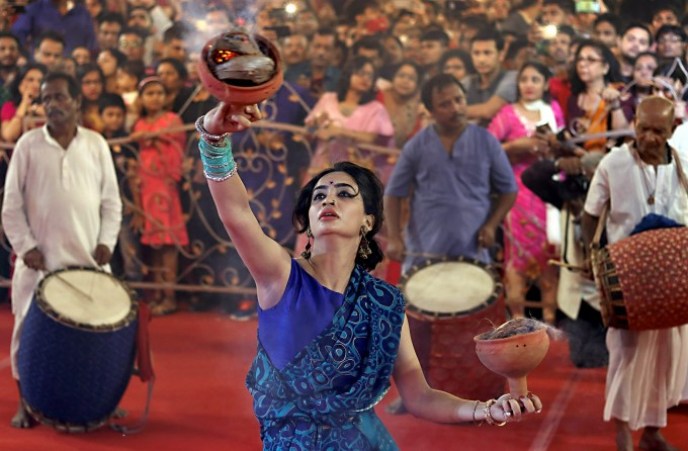
But then, isn’t that also an extension of the Durga Puja Spirit… of Ma Durga visiting her mythical maternal home on Earth for a brief sojourn each year, before returning again to her Heavenly Abode?
And so also for thousands of people living away from their Homes and ancestral lands, flocking on brief visits to the people and places that they have left behind, to partake of the festivities and the company of loved ones, before flying away once again to the faraway climes from whence they came.
In a week of snatched togetherness that would have to make do for the rest of the year.
And perhaps the year after…
And then, like all good things, Durga Puja comes to an end, with the immersion of the Goddess on Vijaya Dashami, the last day of the festival and the brief interlude is over. And it’s time once again, to go back to the Business of Living.
The long farewells, the promises to meet again soon, the familiar lump in the throat as you touch your elders’ feet one last time as you take leave. With the cherished hope in your heart, that one day, you’ll be back – for good.
But till then, there’ll always be “Promises to keep… and Miles to go before I sleep”
]]>